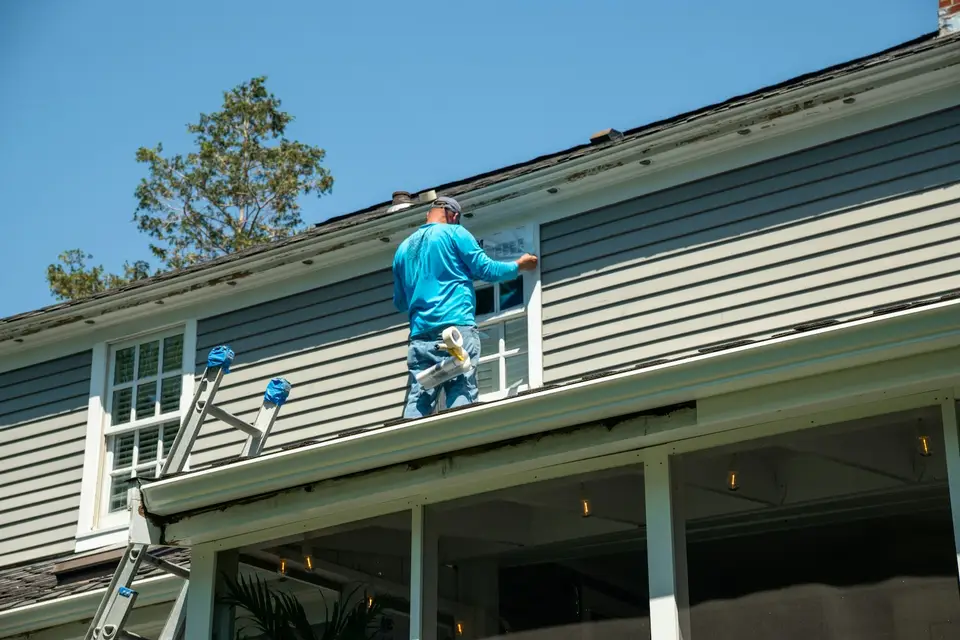
Exterior House Painting in Hopedale: what's different here
Exterior paint in Hopedale takes the same New England beating everywhere: icy winters, humid summers and spring rain. Homes near Hopedale Pond and on shaded lots in Hopedale Village (town center) and Spindleville tend to show mildew and sill rot first, so we inspect those areas closely before quoting.
About 59% of homes were built before 1980 and 35% before 1940; median year built 1959 (ACS 2020-2024 5-year). Many Hopedale homes date to around 1959 or earlier, with wood clapboards carrying decades of paint, some of it lead-based. Scraping more than 20 sq ft outside a pre-1978 home falls under Massachusetts lead-safe rules.
Hopedale grew up around the Draper Corporation, once the largest maker of textile looms in the United States, whose Hopedale plant closed in 1980.
The Hopedale Village Historic District preserves Draper company worker housing, including the duplexes on Dutcher Street built between 1902 and 1907.
Signs you need this service
- Peeling, flaking or chalky paint on siding and trim
- Bare gray wood on window sills, corner boards or the south wall
- Soft or rotted trim, fascia or sills you can press a screwdriver into
- Cracked or missing caulk at windows, doors and trim joints
- Mildew streaks on north walls and under eaves
- Faded color that no longer matches touch-ups
When is the best time to paint a house exterior in New England?
In Massachusetts the practical season runs roughly May through mid-October, with late spring and early fall the best mix of mild temperatures and lower humidity. Paint needs to stay above its minimum temperature and above the dew point for about 48 hours after application, so cold nights and heavy dew shorten the day.
A typical day starts after the morning dew has burned off and ends by mid-afternoon in cool weeks, so the film can dry before dew returns. We also follow the sun around the house, avoiding walls that are in hot direct sun, which can make paint dry too fast and lap. Shoulder-season jobs are booked early, because every crew in New England is chasing the same warm days.
How cold is too cold to paint outside?
It depends on the product. Sherwin-Williams says Duration, Resilience, SuperPaint and A-100 Exterior can be applied and cure down to 35°F, while traditional latex needed 50°F to 60°F. Temperatures should stay in range and above the dew point for 48 hours, and most products need at least 4 hours of dry time before dew forms.
The label is the rule, and it applies to the surface temperature, not just the forecast. A shaded north wall at 8 a.m. in October can be colder and wetter than the air. Source: Sherwin-Williams exterior application FAQs.
- Check air and surface temperature against the product label
- Keep the surface at least a few degrees above the dew point
- Allow at least 4 hours of dry time before evening dew
- Skip the day after heavy rain while wood is still wet
- Watch the 48-hour forecast, not just today
Why do dew point and humidity matter for exterior paint?
When a surface cools to the dew point, moisture condenses on it. Fresh latex that gets wet before it forms a film can stay tacky, wash out, or show surfactant streaks, and paint over damp wood loses adhesion and peels. That is why we check dew point daily and stop early on cool, humid days.
Humid August afternoons with dew points in the 60s and cool October mornings both create risk. We also check siding with a moisture meter before priming, since wood that is still wet from rain or a wash will push paint off from behind.
Should rotted trim be fixed before painting?
Yes. Paint cannot hold soft wood together, and rot keeps spreading under a fresh coat. Rotted sills, corner boards, fascia and trim should be cut back to solid wood and replaced, with new pieces primed on all sides and end cuts sealed, before the house is caulked and painted.
Rot in Massachusetts usually starts where water sits: window sills, the bottoms of door casings and corner boards, fascia ends behind gutters, and the lowest courses of siding. Our carpenters do the repair as part of the paint job, often with PVC trim at high-risk spots. See exterior carpentry and rot repair.
Caulk matters just as much. We seal vertical joints and the top edges of trim, but we never caulk the bottom laps of clapboards, because that traps water behind the siding.
Do I need a lead-safe painter for an older house exterior?
If the home was built before 1978 and the work disturbs more than 20 square feet of exterior painted surface, Massachusetts requires a contractor licensed by the Department of Labor Standards (DLS) for Lead-Safe Renovation. Scraping and sanding a house exterior almost always crosses that line.
Lead-safe work practices outside include plastic sheeting on the ground, closed windows, misting and wet-scraping, and HEPA vacuuming of chips. Open-flame burning is prohibited. The contractor must give you EPA's Renovate Right pamphlet before work starts. Check a contractor's DLS license through the state lead-safe renovation program, and ask for it before signing.
How long does exterior paint last in Massachusetts?
A well-prepped two-coat job commonly lasts many years, but exposure decides it. South- and west-facing walls take the most sun and fail first; north walls collect mildew. Bare-wood spots, open joints and gutters overflowing onto trim shorten the life of any paint, no matter how expensive the can.
Keeping gutters clean, washing mildew off every year or two and touching up sills before they go bare will add years to a paint job. We note the weakest areas on your house at the final walkaround so you know what to watch.
How the job works, step by step
- Free exterior inspectionWe walk the house with a ladder and a moisture meter, probe trim for rot, note peeling by elevation and check the year built for lead-safe rules. You get a written scope with every repair listed.
- Wash the houseSiding is cleaned with a low-pressure wash and mildewcide so paint bonds to clean wood, not chalk or mildew. Then the wood is allowed to dry before any primer goes on.
- Scrape, sand and repairLoose paint is scraped and edges are feathered. Rotted trim, sills and fascia are cut out and replaced with wood or PVC, and the repairs are primed on all sides.
- Prime bare wood and caulk jointsEvery bare spot gets an exterior primer. Open joints around windows, doors and trim are filled with a high-grade exterior caulk, leaving clapboard laps open so the wall can drain and breathe.
- Two finish coats, weather permittingWe apply two coats of 100% acrylic exterior paint, checking air and surface temperature and dew point each day. We start after the morning dew dries and stop early enough for the paint to set before evening dew.
- Final walkaround and cleanupWe walk all four sides with you, touch up anything you mark, re-hang shutters and fixtures, and clean up paint chips. Payment is due only after you approve the job.
What it costs in Massachusetts
These are typical Boston-area ranges reported by Angi; repair figures are national ranges reported by Fixr. Your final price comes after a free on-site estimate.
| Job | Typical MA range |
|---|---|
| Average full exterior repaint (Boston area) | about $5,285 |
| Most exterior projects (Boston area) | $3,198 – $7,782 |
| Fascia repair before painting (national) | $6 – $16 per linear ft |
| Fascia replacement (national) | $15 – $20 per linear ft |
| Soffit repair (national) | $6 – $20 per linear ft |
Source: Angi, cost to paint a house exterior in Boston, MA