Gutter Cleaning in Marlborough: what's different here
Many streets in Marlborough are lined with mature oaks and maples, so gutters fill fast every fall. On Marlborough gutter calls, from Downtown Village and French Hill to the town line, we flush every downspout and check where the water lands, because a clogged leader is one of the most common causes of wet basements.
About 57% of homes were built before 1980 and 21% before 1940; median year built 1974 (ACS 2020-2024 5-year). Marlborough homes from around 1974 usually have 5-inch aluminum gutters that can be undersized for today’s heavier storms, with downspouts often tied into older underground drains that clog with roots.
By 1890 Marlborough was a major shoe-manufacturing center, and multi-unit worker housing blocks built by shoe manufacturers still stand near former factory sites such as Devens and Elm Streets.
The bell from John Brown's fort at Harpers Ferry, brought home by a Marlborough Civil War company, hangs in a tower at Route 85 and Main Street.
Signs you need this service
- Water sheeting over the gutter edge in heavy rain
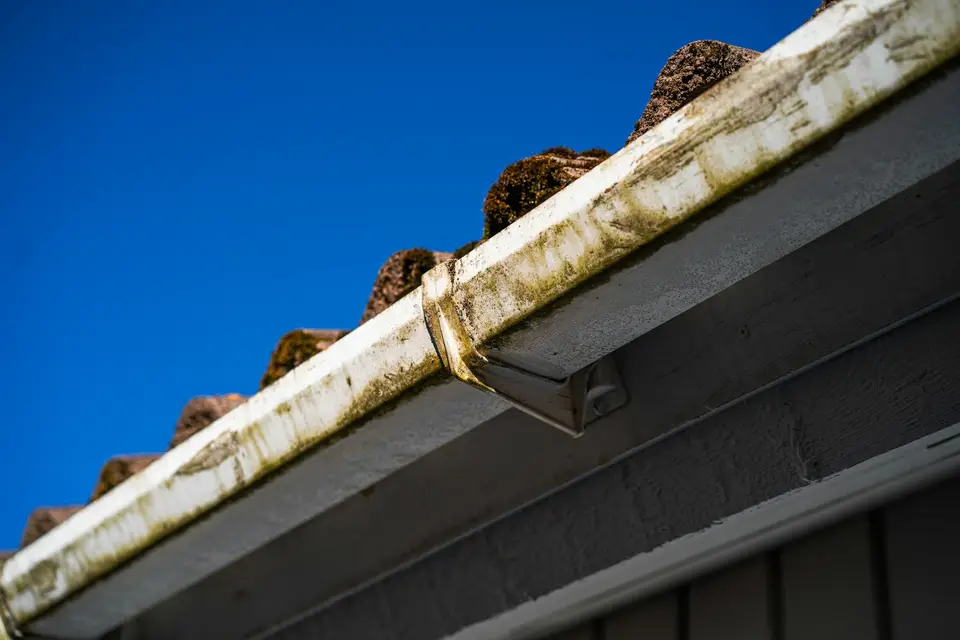
- Seedlings or moss growing in the gutters
- Gutters sagging between hangers or pulling off the fascia
- Peeling paint or soft, rotted fascia behind the gutter
- Puddles, washed-out mulch or a damp basement wall near a downspout
- Thick icicles and ice building along the eaves in winter
- Downspouts that drip at the joints or barely run
When should gutters be cleaned in Massachusetts?
At least twice a year: in late fall after most leaves are down, usually November in MetroWest since oaks drop late, and in late spring after maple seeds and pollen. Homes under tall trees or pines may need a third cleaning. The fall cleaning matters most, because gutters freeze full if leaves are left in them.
Cleaning too early in the fall is a common mistake: the gutters look great in mid-October and are packed again three weeks later. We schedule fall cleanings after the bulk of the leaf drop but before the ground and gutters freeze. If you have big oaks near the house, a second late-season pass can be worth it.
Spring cleanings catch maple “helicopters,” catkins, pollen mats and the shingle granules that wash off over the winter. That grit builds up in the bottom of the gutter and slows drainage even when the gutters look clear from the ground.
Do clogged gutters cause ice dams?
Not by themselves. Ice dams form when heat leaking from the house warms the roof and melts snow that refreezes at the cold eaves, as UMass Amherst explains. But gutters packed with frozen leaves give the ice a head start, add weight and push meltwater toward the fascia. Clean gutters limit damage; air sealing and insulation fix the cause.
The UMass guidance is clear that the real cure is stopping heat and air leaks into the attic, from bath fans, top plates, recessed lights and chimneys, then adding insulation. That is why we often pair a gutter visit with an attic look and refer the fix to our insulation team.
Maintenance also matters for insurance. The Massachusetts Division of Insurance says ice dam damage may be covered if it is sudden and not caused by lack of maintenance. A dated record of fall gutter cleaning, with photos, is simple proof that you kept up with your home. If water is already coming through a ceiling, see our storm and ice dam damage service.
How far should downspouts drain away from the foundation?
Most guidance says downspouts should discharge at least 4 to 6 feet from the foundation, and up to 10 feet on flat lots or clay soil. A splash block alone moves water only about 2 feet. The ground should slope away too; residential code calls for at least 6 inches of fall in the first 10 feet.
A single downspout can carry hundreds of gallons in one New England downpour, and if it empties at the foundation, that water ends up against your basement wall. Many “leaky basement” calls in MetroWest turn out to be a downspout or a clogged underground leader, not a foundation failure.
Our usual fixes are extensions, splash blocks and re-routing a downspout away from walkways where it would freeze into an ice patch. If an underground drain is clogged with roots or collapsed, we document it and recommend the right repair. Where soil slopes toward the house, regrading is the long-term fix.
- Extension or buried leader carrying water 4–10 feet out
- Discharge away from driveways and walks to avoid winter ice
- Soil sloping away from the foundation, not toward it
- Underground drains tested for flow at every cleaning
Why do my gutters overflow even when they are clean?
Clean gutters usually overflow because of capacity or pitch, not debris. Common causes are a 5-inch gutter on a large or steep roof, too few downspouts, gutters pitched the wrong way, a clogged downspout elbow or underground drain, or a roof valley dumping a concentrated stream past the gutter lip.
We test each run with a hose to see where water actually goes. Simple fixes include adding a downspout, re-pitching a sagging section, adding a splash guard at a valley or upsizing the outlet. When a whole system is undersized or the fascia behind it is rotten, we give you a written estimate for the repair or our exterior carpentry crew handles the fascia and trim.
Are gutter guards worth it in New England?
Gutter guards reduce cleaning but don’t eliminate it. Fine debris such as pine needles, maple seeds and shingle grit still collects, and many guards must be removed to clean underneath. In heavy snow areas, some styles can hold ice at the eaves. They make the most sense on homes under large trees where gutters clog several times a year.
If you are considering guards, have the gutters cleaned, flushed and re-pitched first; a guard on top of a sagging, half-full gutter only hides the problem. We are happy to give you an honest opinion at a cleaning visit.
How the job works, step by step
- Walk-around inspectionFrom the ground we note overflow stains, sagging runs, loose downspouts, where each downspout discharges and how the soil slopes at the foundation.
- Hand-clear every gutterUsing ladders with stand-offs that keep weight off the gutter, we scoop out leaves, seeds and shingle grit by hand and bag the debris instead of blowing it across your yard.
- Flush the downspoutsWe run water through every gutter and downspout, clear clogged elbows and test any underground leader for flow. Blocked buried drains are noted with photos.
- Check pitch, hangers and seamsGutters should fall toward the outlet, commonly about 1/4 inch per 10 feet. We tighten or add hangers, reseal leaking corners and end caps, and flag any section that needs re-pitching.
- Fix the dischargeDownspouts that dump at the foundation get extensions or splash blocks to carry water several feet out. Grading problems are documented so you can plan a fix.
- Photo reportYou get before-and-after photos and a short list of anything we found, such as rotted fascia, loose flashing or damaged gutter sections, with a price to fix it if you want.
What it costs in Massachusetts
These are typical ranges reported by Angi for the Boston area. Price depends on linear footage, the number of stories, roof pitch and how full the gutters are; your final price comes from a free estimate.
| Job | Typical MA range |
|---|---|
| Average gutter cleaning (Boston area) | ≈ $167 |
| Most gutter cleanings (Boston area) | $126 – $219 |
| Per linear foot of gutter | $0.95 – $2.25 / linear ft |
| By home size, first floor vs second floor | ≈ $0.40 vs $0.80 / sq ft |
| Multi-story or steep roofs | Toward the top of the range or above |
| Hanger, seam or downspout repairs | Quoted on site, in writing |
Source: Angi — Gutter cleaning cost in Boston, MA
Standards & references
- UMass Amherst Building & Construction Technology — Preventing ice dams
- University of Minnesota Extension — Dealing with and preventing ice dams
- Mass.gov — Frequently asked questions about homeowners insurance
- Mass.gov — Winter weather and insurance
- This Old House — How to drain downspout water away from a house