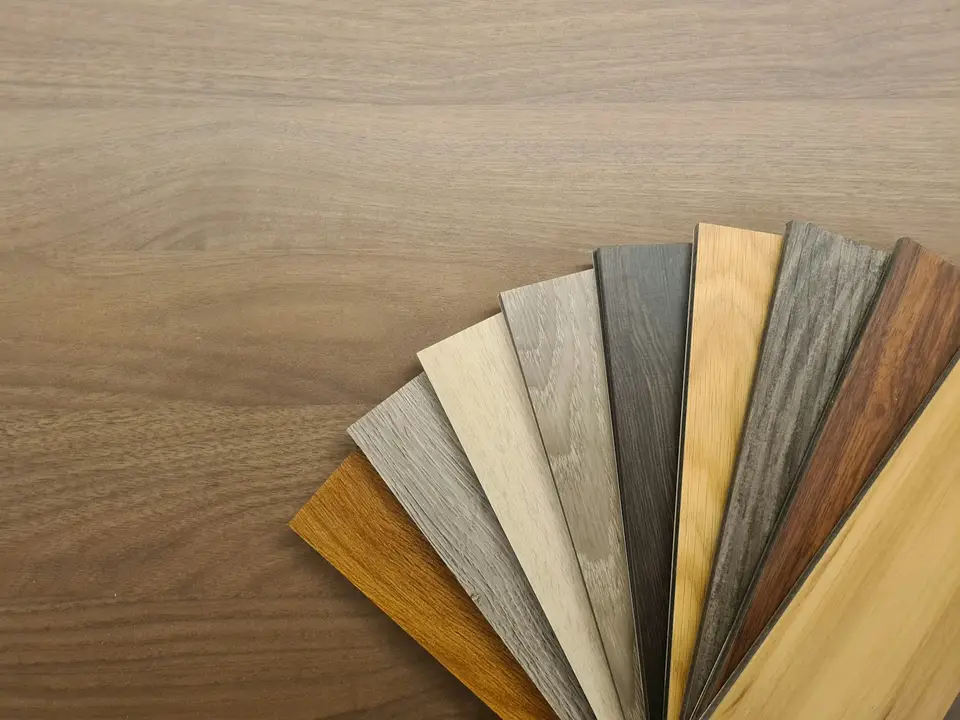
Luxury Vinyl Plank (LVP) Flooring in Hudson: what's different here
Basements in Hudson, especially near Assabet River, see spring groundwater and summer humidity, which is why waterproof vinyl plank is the floor we install most often below grade in Hudson. From Downtown Hudson (historic Feltonville) and Gleasondale (shared with Stow) across Middlesex County, we test the slab first and check older homes for asbestos-era tile before covering anything.
About 60% of homes were built before 1980 and 23% before 1940; median year built 1970 (ACS 2020-2024 5-year). In Hudson houses from around 1970, kitchens and baths often still have original sheet vinyl or 9×9 tile that may contain asbestos; once tested, floating new LVP over intact tile is often the cleanest option.
From about 1850 until the last shoe factory burned in 1968, Hudson was a shoe mill town with as many as 17 factories, many powered by the Assabet River.
Wealthier residents built Queen Anne Victorian homes that still stand, including the 1895 Colonel Adelbert Mossman House on Park Street, and the Silas Felton Historic District marks the old Feltonville center.
Signs you need this service
- A basement with occasional dampness or a past water event
- Kitchen or bathroom with cracked tile or worn sheet vinyl
- Carpet or laminate that keeps getting wet and smelling musty
- Pets and kids, and you want a quiet, waterproof floor
- A rental or condo turnover that needs a fast, durable install
- Old 9×9 tiles or sheet vinyl you would rather cover than tear out
What is the difference between LVP, LVT, SPC and WPC?
LVP and LVT describe the shape: planks or tiles. SPC (stone plastic composite) and WPC (wood plastic composite) describe the rigid core in click products. SPC is denser, more dent-resistant and steadier in temperature swings; WPC has a foamed core that is softer, warmer and quieter underfoot. Both are waterproof.
Fixr’s national guide puts SPC materials around $3.50 to $7 per sq ft and WPC around $4 to $12, and describes WPC as softer and quieter, SPC as slightly more durable.
- Glue-down (dryback) LVP/LVT: thin and flexible, glued to a very flat subfloor; stays put under heavy rolling loads
- SPC rigid core click: the most common choice for Massachusetts basements
- WPC rigid core click: more comfortable and quieter for main living areas
- Sheet vinyl: few or no seams, useful in laundry rooms
What wear layer thickness should vinyl plank have?
The wear layer is the clear top film, measured in mils (thousandths of an inch). Around 12 mil suits light residential rooms like bedrooms; 20 mil is the common pick for busy homes, kitchens and pets; 28 mil and up is meant for commercial traffic. Overall plank thickness matters less than the wear layer.
Do not confuse millimeters (total plank thickness, such as 5 mm or 6.5 mm) with mils (wear layer). A thick plank with a 6-mil wear layer will scuff faster than a thinner plank with 20 mil. Check the spec sheet and the warranty, which is usually tied to wear-layer thickness.
Is vinyl plank the best floor for a basement?
For most Massachusetts basements, yes. Rigid-core vinyl plank is waterproof through the core, floats over concrete and can often be lifted, dried and reinstalled after minor water. It does not fix moisture, though: we test the slab first and recommend a dehumidifier to keep the space at 30 to 50% humidity.
A waterproof floor is not a waterproof basement. Water trapped under the planks can still grow mold on the slab or the underside of the floor. Grading, gutters and a working sump come first.
If your basement has already taken on water, call our water damage restoration crew first for drying and moisture documentation; the new floor goes in once readings are back to normal.
Can vinyl plank go in a bathroom?
Yes. Vinyl is one of the best bathroom floors because the planks are waterproof. The weak points are the edges, so we leave the required expansion gap, seal the perimeter at tubs and showers where the manufacturer allows, and cut cleanly around the toilet flange. Shower floors themselves still need tile.
Removing and resetting a toilet involves plumbing. In Massachusetts, plumbing work is done only by licensed plumbers, so on bathroom flooring jobs that part is handled by our licensed plumbing partners. Planning a bigger update? See bathroom remodeling.
Can you install vinyl over old floor tile that may contain asbestos?
Often the safest option is to leave intact old tile in place and float new vinyl plank over it, with no sanding, scraping or grinding. But 9×9 tiles and black “cutback” mastic common in homes built before the 1980s may contain asbestos, so a licensed inspector tests them before anything is disturbed.
Massachusetts rules presume old floor tile, sheet flooring and mastic contain asbestos unless lab analysis or manufacturer data shows otherwise, and they prohibit sanding, dry-scraping, grinding or sawing those materials (454 CMR 28.11). MassDEP also requires an asbestos survey before renovation that may disturb suspect material. The EPA is blunt: do not sand or try to level asbestos flooring or its backing.
If removal is the right call, a licensed asbestos abatement contractor removes it before our crew arrives, and we coordinate the schedule with selective demolition of anything else coming out.
- Do not sand, grind or dry-scrape old tile or black adhesive
- Do not nail or screw underlayment through untested tile
- Do test first; floating over intact tile is often the cleanest route
Click or glue-down vinyl: which is better?
Click (floating) rigid-core vinyl installs faster, tolerates minor subfloor flaws and can be lifted after water. Glue-down vinyl is thinner, quieter and stays put under heavy rolling loads, in large open areas and in rooms with strong sun, but it needs a near-perfectly flat, dry subfloor and is harder to replace.
Floating floors should not be pinned under kitchen islands or built-in cabinets, because the floor needs to move. We set cabinets first and run the floor to them, or choose glue-down for those layouts.
How the job works, step by step
- Free estimate, moisture and flatness checkWe test slab or subfloor moisture and check flatness with a straightedge; rigid-core products commonly allow about 3/16 inch over 10 feet, while glue-down needs tighter.
- Old-flooring assessmentResilient tile, sheet vinyl or black mastic in older homes is sampled by a licensed asbestos inspector before anything is disturbed, as Massachusetts rules require.
- PrepWe remove carpet and non-asbestos flooring, patch and level with cement-based compound, grind high spots and undercut door jambs.
- Acclimation and layoutPlanks acclimate to room temperature as the manufacturer specifies. We pull from several boxes at once to mix the pattern and plan seams and transitions.
- InstallationClick SPC or WPC floats with a perimeter gap; glue-down LVT is set in the specified adhesive and rolled. In bathrooms, edges at tubs and showers are sealed where the manufacturer allows.
- Trim and walkthroughBaseboard or quarter round, transitions and stair nosings are fitted. You get spare planks, care instructions and your written workmanship guarantee.
What it costs in Massachusetts
These are typical ranges reported by LocalServiceCost for the Boston area and by Fixr nationally (updated January 2025); MetroWest prices often run slightly below Boston. Asbestos removal is done by a licensed abatement contractor and priced separately. Your final price comes after a free on-site estimate.
| Job | Typical MA range |
|---|---|
| LVP installed, Boston area | $6–$12 per sq ft |
| LVP install, 500 sq ft (Boston) | $3,000–$6,000 |
| LVP installed, most projects nationally (Fixr) | $5–$12 per sq ft |
| SPC materials only (Fixr) | $3.50–$7 per sq ft |
| WPC materials only (Fixr) | $4–$12 per sq ft |
| 9×9 tile and mastic removal by licensed abatement contractor (Boston) | $8–$15 per sq ft |
| Subfloor repair and leveling (Boston) | $300–$2,500 |
Source: LocalServiceCost — Boston flooring costs