Water Damage Restoration in Marlborough: what's different here
Basements near Assabet River in Marlborough take on groundwater during spring thaw and heavy nor'easter rain, so on every Marlborough water damage call we check foundation walls, sill plates and slab moisture, not just the wet carpet. We see the same pattern in neighborhoods like Downtown Village and French Hill, and we bring the materials to rebuild, not just the drying equipment.
About 57% of homes were built before 1980 and 21% before 1940; median year built 1974 (ACS 2020-2024 5-year). With a median year built of 1974, many Marlborough homes have early drywall, original 1970s and 80s finishes, and water heaters and copper lines at failure age. Popcorn ceilings, joint compound and sheet-vinyl mastic from that era can contain asbestos, so we arrange testing before we cut.
By 1890 Marlborough was a major shoe-manufacturing center, and multi-unit worker housing blocks built by shoe manufacturers still stand near former factory sites such as Devens and Elm Streets.
The bell from John Brown's fort at Harpers Ferry, brought home by a Marlborough Civil War company, hangs in a tower at Route 85 and Main Street.
Signs you need this service
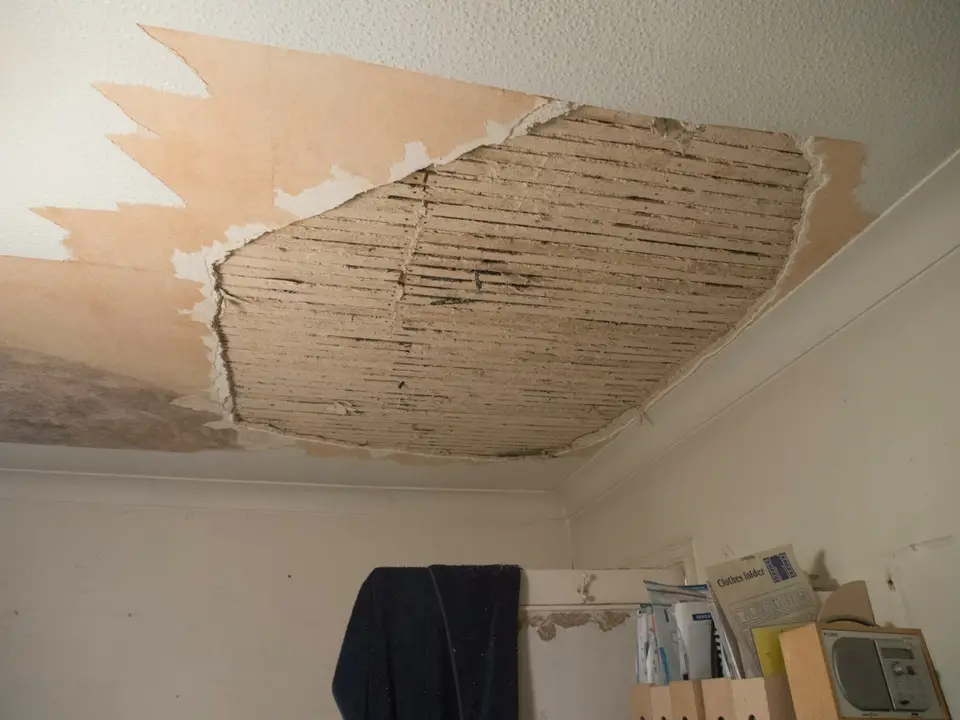
- Water stains, bubbling paint or a sagging spot on a ceiling
- Soft, swollen or crumbling drywall along the baseboards
- Hardwood cupping or buckling, or LVP lifting at the seams
- A musty smell in the basement or a closet after a leak
- Standing water from a burst pipe, water heater or washer hose
- Water coming through a ceiling or window head during a winter thaw
- A jump in the water bill with no leak you can see
What should I do in the first 60 minutes after water damage?
Shut off the water at the main valve and stay away from wet outlets and cords. Cut power to the affected rooms only if you can reach the panel from a dry spot. Photograph everything before moving it, lift valuables off the floor, and call a restoration crew right away: EPA advises drying within 24 to 48 hours.
The first hour decides how much of the house gets rebuilt. Water keeps wicking up drywall and soaking into subfloors for as long as it sits, and clean water can degrade into a contaminated category with time and warmth. EPA puts it plainly: dry water-damaged areas and items within 24 to 48 hours to prevent mold growth.
Here is the checklist we give homeowners on the phone. Text us photos at (774) 285-1518 while you work through it, so the crew shows up with the right extractors and enough dehumidifiers.
- Close the main shut-off. It is usually in the basement where the water line comes through the foundation, next to the meter. For a leaking water heater, close the cold inlet valve and turn off the gas or the breaker.
- Don't walk into standing water if outlets, cords, a furnace or a boiler are under water. Call the utility or the fire department instead.
- Photograph and video every room before moving anything: ceilings, walls, floors, contents and the source itself.
- Lift rugs, slide foil or wood blocks under furniture legs, and carry electronics, documents and photos to a dry floor.
- Don't use a household vacuum on water, and don't switch on ceiling lights or fans under a wet ceiling.
- If the water came from a toilet, a floor drain or outside floodwater, treat it as contaminated and keep people out. Our sewage cleanup page explains why.
What are Category 1, 2 and 3 water damage?
The IICRC S500 standard sorts water by contamination. Category 1 is clean water, such as a broken supply line. Category 2 is grey water with some contamination, such as a washing machine overflow. Category 3 is grossly contaminated water, such as sewage or rising floodwater. The category decides what can be dried and what has to be removed.
Category describes the water, not the size of the mess. A small toilet overflow with waste in it is Category 3. A clean supply-line leak left sitting in a warm basement for several days can degrade into Category 2 or 3. On Category 3 losses, porous materials the water touched, such as carpet, pad, insulation and drywall, are generally removed rather than dried.
Class describes how much water has to be evaporated, and it sets how much equipment we install. Class 1 is a small, partial-room loss with mostly low-porosity materials. Class 2 is a whole room with wet carpet and water wicking up the walls. Class 3 is the wettest, often water from above soaking ceilings, walls and insulation. Class 4 is specialty drying for materials that hold water deeply: hardwood, plaster, brick and concrete. Many older Massachusetts homes with plaster walls and oak floors end up in Class 4.
- Category 1 (clean): broken supply line, overflowing sink or tub from the faucet, failed water heater.
- Category 2 (grey): washing machine or dishwasher discharge, toilet overflow with urine but no feces.
- Category 3 (black): sewer backup, toilet overflow with feces, river or surface floodwater entering the house.
How long does it take to dry out a house after water damage?
Most residential dry-outs need about three to five days of drying equipment once wet materials are opened up. Hardwood, plaster and concrete (Class 4) can take longer. The IICRC does not set a fixed number of days: drying is finished when moisture readings reach the drying goal, not when the calendar says so.
We take readings from an unaffected "dry standard" in your own home, such as the same oak in a dry bedroom or the same drywall on a dry wall, and dry the wet materials until they match. Readings are logged every day and you get a copy. Pulling equipment a day early to save rental time is how hidden mold and cupped floors show up a month later.
After drying comes the rebuild, which most mitigation companies don't do. On a typical first-floor or finished-basement loss, the sequence is drying, then drywall repair (hang, tape, three coats of compound, sand), then interior painting, then floors: sand and refinish, or weave in new boards, through our hardwood floor refinishing crew. Joint compound needs dry time between coats, so the drywall stage alone usually spans several days.
Does homeowners insurance cover water damage in Massachusetts?
Usually, when the damage is sudden and accidental, such as a burst pipe, a failed supply line or an appliance leak. Massachusetts policies generally exclude gradual leaks, wear and tear, flood, and sewer backup unless you bought an endorsement. Your insurer decides coverage. We give you the photos, moisture logs and itemized estimate the claim file needs.
Water is the biggest homeowners claim category in the state. The Massachusetts Division of Insurance reports that 48.6% of 2024 homeowners claims were non-flood water and freezing losses (MA Division of Insurance, January 2026). The Division also notes that burst-pipe damage is typically covered only if the home was heated and not left unoccupied, and that flood needs a separate policy (Is my flood damage covered?).
What we provide: date-stamped photos before, during and after the work; a moisture map and daily drying log; a list of removed materials with the reason each one came out; and an itemized estimate for mitigation and repairs. We don't act as your adjuster and we never waive or absorb deductibles. Coverage decisions are your insurer's, and we make sure the file they review is complete.
- Report the loss to your insurer promptly and write down the claim number and adjuster's name.
- Take reasonable steps to stop further damage, which most policies require, and keep every receipt.
- Keep a sample of damaged material, such as a square of carpet or the failed hose, until the adjuster has seen it.
- List damaged contents room by room, with approximate age and value.
- Ask your contractor for copies of every moisture log and the final itemized estimate.
Why use one company for water damage cleanup and repairs?
Because the hand-off is where water jobs go wrong. When the drying company leaves and a separate contractor shows up weeks later, nobody owns the gap. I&D Innovation dries, rebuilds and finishes the room with one crew and one written workmanship guarantee, from the first extractor pass to the last coat of paint.
Most restoration franchises stop at "dry" and hand you a list of contractors to call. Our crew includes drywall finishers, carpenters, painters and floor installers, so the cuts we make during tear-out are planned for the rebuild: flood cuts at a clean height, trim pulled and labeled for reinstallation, hardwood dried in place when the readings say it can be saved.
You also get one schedule and one contact in English or Portuguese, a free estimate, a finish date we commit to in writing, and you pay only when the work is completed. If the source is a pipe or fixture, the plumbing repair is made by a licensed plumbing partner, as Massachusetts law requires.
- Extraction and structural drying following IICRC S500 procedures
- Drywall and plaster repair, taping and finishing
- Trim, door and cabinet carpentry
- Interior painting with stain-blocking primers
- Hardwood refinishing, board replacement, LVP and laminate
How the job works, step by step
- Emergency call and safety checkWe answer emergency calls 24/7, confirm the water is shut off and the electrical is safe, and tell you what to move while we drive over.
- Inspection and moisture mappingWe trace the source and map every wet material with pin and pinless moisture meters and a thermal camera. Then we classify the loss by IICRC S500 category (how contaminated the water is) and class (how much is wet).
- Water extractionTruck-mounted or portable extractors pull standing water out of carpet, pad and floors. Every gallon removed as liquid is a gallon the dehumidifiers don't have to evaporate.
- Controlled tear-outOnly what can't be dried, or isn't safe, comes out: wet pad, soaked insulation, swollen particleboard, and drywall cut on a straight line above the wicking height so the patch finishes cleanly.
- Structural dryingAir movers and LGR dehumidifiers run on a written drying plan. We log readings daily against dry reference points in your own home until every material reaches its drying goal.
- Rebuild and finishThe same crew hangs and finishes drywall, resets trim, paints, and refinishes or replaces floors. There is no hand-off between a drying company and a separate contractor.
- Final walk-throughYou get the moisture logs, the photo record and a walk-through of the finished room. The work carries our written workmanship guarantee.
What it costs in Massachusetts
Typical ranges reported by Angi for the Boston area (2026 data); MetroWest jobs often land a little lower. Rebuild rows use Angi's Boston drywall, painting and refinishing figures. Your actual price comes from a free on-site estimate.
| Job | Typical MA range |
|---|---|
| Water damage mitigation, most Boston-area jobs (average about $3,148) | $1,584 – $4,713 |
| Mitigation per square foot of affected area | $2.45 – $6.13 / sq ft |
| Drywall repair, about a 10 sq ft section | $545 – $815 |
| Repainting one room (average about $1,191) | $433 – $1,733 |
| Hardwood floor sanding and refinishing | $4 – $9 / sq ft |
Source: Angi — Boston water damage repair cost